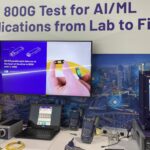
Before those 800G links can operate, they need testing.
San Diego — The 2024 Optical Fiber Communications Conference (OFC) took place here from March 25 to 28. While companies highlighting their optical transceiver modules, semiconductors, and network equipment all touted how they support AI and data centers, none of that happens without test equipment.
Optical communications testing mostly takes place at the physical layer, starting even before lasers drive signals representing data bits down the fiber. PHY-layer testing keeps gaining importance as signal modulation gets ever more complex. Not only that, but physics gets in the way. Each time we introduce a new symbol rate or new modulation, issues arise that didn’t appear at lower speeds.
With current optical data rates of 400 Gb/sec (400G) and 800 Gb/sec (800G), and with 1.6 Tb/sec (1.6T) coming, non-return-to-zero (NRZ) modulation has reached its limit. Even PAM4 may someday show its age as we move to coherent optics. The photos and videos show some of what we saw in the exhibit hall.
 Anritsu exhibited optical spectrum analyzers and OTDRs, plus a mmWave test setup for wireless. The photo shows the MP2110A sampling oscilloscope/BERT testing an 800G optical link. Also on display was the MP1900A signal-quality analyzer for Ethernet, PCIe, InfiniBand, and other optical and electrical interfaces.
Wireline test-equipment company EXFO came to OFC to demonstrate several products that cover optical test from the bench through manufacturing to the field. The video shows a model BA-4000-L2 traffic and BER analyzer testing an 800G optical transceiver. The company also exhibited:
- FTB-1 field tester for 1G to 400G Ethernet plus Fibre Channel. This modular tester provides protocol analysis for service activation.
- LTB-8, a rackmount modular system for testing CFP4 and QSFP+/QSFP28 interfaces in the lab.
- OPAL-MD platform for testing optical ICs.
Keysight Technologies, which gave the press a preview of a 1.6T transmission, had a demonstration on the show floor showing a path to a single 448 Gb/sec digital link. In the video below, Greg LeCheminant showed how the company used its arbitrary waveform generator and oscilloscope to generare and view unstructured bits sent using 155 Gbaud PAM4, 310 Gb/sec. That’s a jump from 100 Gbaud, 200 Gb/sec.
 multiLane exhibited its ML4015E single-channel oscilloscope, available in optical and electrical versions. The company also previewed its ML4015F, which, when released, will support 112 Gbaud PAM4 (224 Gb/sec) links. Four such lanes make 800 Gb/sec optical links possible. According to a preliminary datasheet provided by multiLane, the ML4015F has an optical 60 GHz bandwidth and an electrical bandwidth of 70 GHz.
The Spirent Communications booth included a rack of equipment for testing 100G (TestCenter M1), 400G (TestCenter A2), and 800G (TestCenter B2) optical interfaces. The video shows optical modules such as QSFP-DD and OSFP.
Viavi also exhibited test equipment for engineering, manufacturing, installation, and maintenance. The VIAVI ONE LabPro consists of a controller and the HSE-800 module, which lets you connect QSFP and QSFP-DD optical transceivers for testing. The system supports 128 800G, 256 400G, and 1014 100G transceivers.
 Viavi also exhibited its Multiple Application Platform (MAP) System, which lets you install modules such as light sources and power meters for testing optical networks. The MAP system is available with three or eight slots.
 Yokogawa exhibited several of its optical test instruments. Models included:
- AQ6372E, AQ6374E, AQ6375E optical spectrum analyzer
- AQ7280, AQ1000, AQ1210D OTDR
- AQ2200 modular optical test system