Fixed-wireless access is a special use case of enhanced mobile broadband, one of the three use cases specified for 5G. FWA brings different challenges for deployment than eMBB.
by Sridhar Bhaskaran, Rakuten Symphony
Mobile network operators (MNOs) are at the beginning of a wave of delivering new 5G stand-alone (SA)-based data services. Where 4G has one defined data service, 5G has four core mobile data services leveraging different features of the technology.
- Ultra-Reliable Low Latency Communications (URLLC), which leverages 5G’s less than 1 ms over-the-air low latency and reliability guarantees (less than 0.001% of 20-byte packet delivery failures after 1 ms).
- Massive Machine Type Communications (mMTC) provides connectivity for up to 1 million simultaneous IoT devices per square kilometer to support IoT sensor applications. The service features a latency of 50 ms and high reliability.
- Enhanced Mobile Broadband (eMBB) is a 5G service category that defines a minimum data transfer rate with a peak of several Gbps of download throughput and over-the-air low latency.
- Fixed Wireless Access (FWA) is a data service based on eMBB but with mobility features disabled. It is optimized for broadband wireless services for residential or enterprise applications underserved by cable or fiber-optic technologies. FWA is not defined as an explicit use case of 5G by 3GPP but is rather realized as a special case of eMBB.
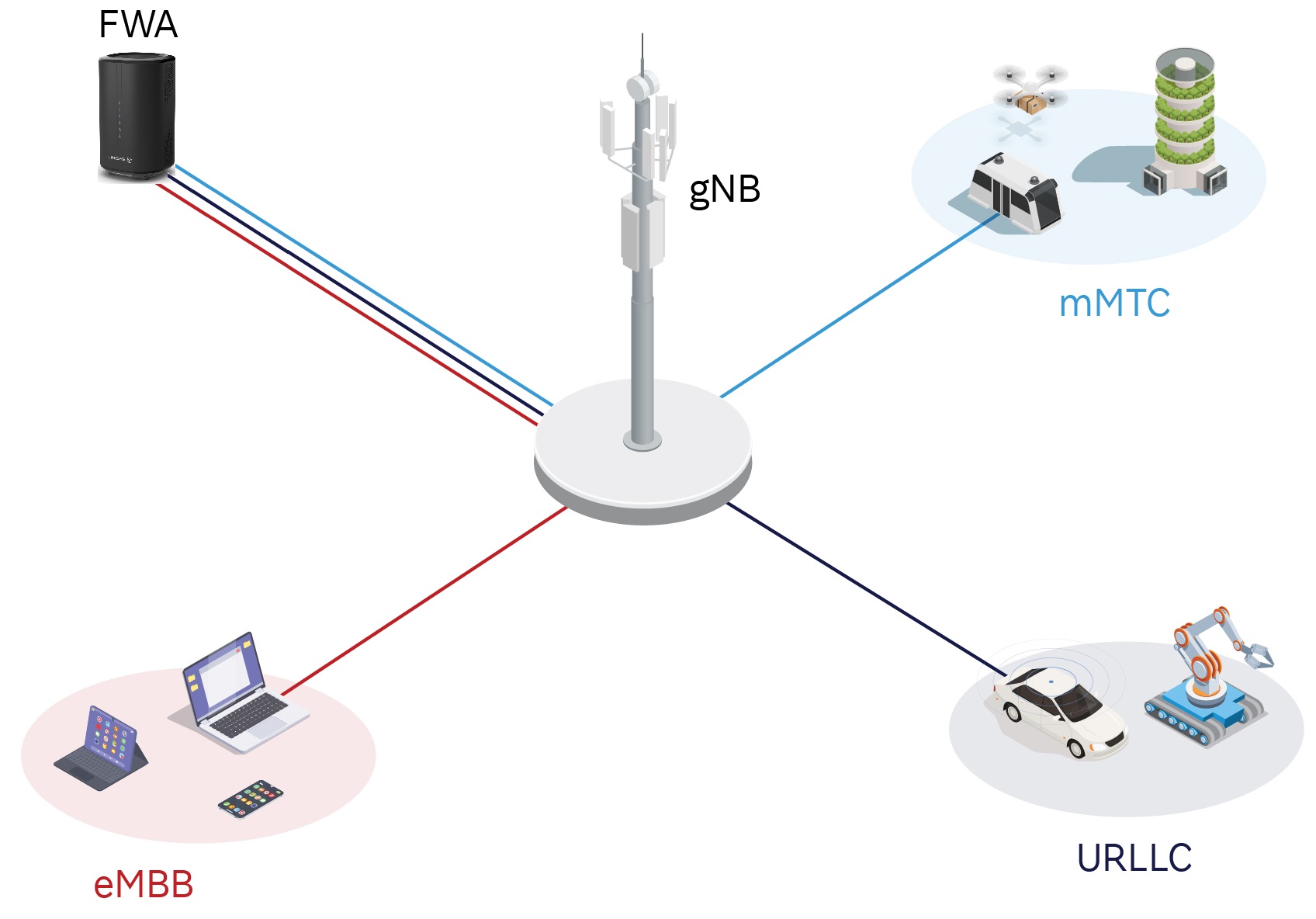
Figure 1. 3GPP defines eMBB, URLLC, and mMTC, with FWA as a special use case of eMBB.
Of these four services shown in Figure 1, MNOs have two 5G data services, namely FWA and eMBB, both of which are available today. Operators can roll out both services in non-standalone as well as standalone networks. URLLC and mMTC services, however, require stand-alone 5G networks and are still not fully market-ready. These services are complex to deploy. You can consider them somewhat niche services compared to the broad appeal of eMBB and FWA, both of which are direct replacements and upgrades for popular consumer data services.
eMBB defined
eMBB is defined as a use case by ITU-R in IMT-2020 requirements (M.2083 specification), and the minimum performance requirements are defined in the M.2410 specification. Based on these requirements, the 3GPP specifications meet the needs of a wide range of mobile applications, including streaming of ultra-high definition (UHD) and 8K video, virtual reality, augmented reality, cloud gaming, and business applications on the go such as video conferencing, data transfers, and cloud data updating or downloading.
To achieve these data rates, eMBB requires wide spectrum bands and specialized antenna technology, including massive multiple input, multiple output (mMIMO) antennas, and beamforming.
3GPP has defined two frequency ranges for 5G data services: FR1 (410 MHz to 7.125 GHz) and FR2 (24.25 GHz to 71.0 GHz). FR1 is commonly referred to as sub-6 GHz, and FR2 is also called millimeter wave (mmWave). The frequencies in between are called FR3, though they have not been allocated for 5G.
To reach the peak throughput requirements specified in ITU-R IMT-2020 requirements M.2410 for eMBB, FR2 frequencies are required because of their wide bandwidth. It can, however, also operate using the FR1 spectrum but with reduced peak bandwidth due to a lack of wide spectrum bands. Carrier aggregation can combine multiple noncontiguous FR1 frequency bands, thus expanding the download connection bandwidth.
While FR2 has large blocks of spectrum available for bandwidth, the transmission range of these signals is limited to 100 m to 200 m. Fr2 signals degrade significantly when passing through walls or other obstructions. The use of FR2 also requires a significant expansion of the RAN infrastructure to ensure ubiquitous coverage, as well as a refresh of UE to add radios operating in the FR2 frequency bands. Energy efficiency is an important issue for network buildouts, and the use of mmWave and mMIMO technologies increases power consumption.
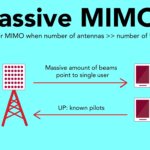
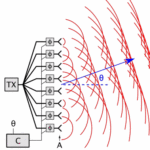
mMIMO is a technology that uses up to 32, 64, or 128 antennas to provide multiple streams of data between a base station and UEs. The mMIMO antenna uses phased-array technology to enable beamforming that directs the antenna beams to areas that need bandwidth. mMIMO and beamforming provide the ability to fill in dead spots and redirect capacity as usage patterns change.
Mobility adds complexity
Deploying an eMBB service requires more signaling capacity handling than FWA and its stationary users because it needs to support hundreds or thousands of mobile users.
To handle each user’s mobility, the gNodeB base station requests the UE to track and measure the signal strength of different frequencies and constantly report it. Based on that, the network decides which target frequency to hand over to users as they move from one base station to another. The event reporting thresholds for different target frequencies are usually configurable.
An eMBB service must also constantly establish and tear down the radio contexts of each UE. This connection might be long-lived or only last for seconds or minutes as users check email or briefly use an app.
FWA defined
FWA provides an always-connected service from the customer premises equipment (CPE) to the 5G network core. It is suitable for residential and enterprise high-speed data services and is ideal for stationary IPTV or streaming services and VoIP.
Cellular FWA is a relatively new idea. WiMAX, a technology that was launched in the mid-2000s, was created for FWA applications but did not see commercial success. The use of cellular technology for FWA has emerged with the high data throughput available in 5G. 4G networks used 20 MHz carriers that offered peak download of 150 Mbps with single 20 MHz carriers and up to 1 Gbps with multiple carriers aggregated through carrier aggregation. With 400 MHz carriers available in 5G FR2 and 100 MHz carriers available in FR1, 5G has enough bandwidth to provide a neighborhood with a service delivering hundreds of megabytes of data per household.
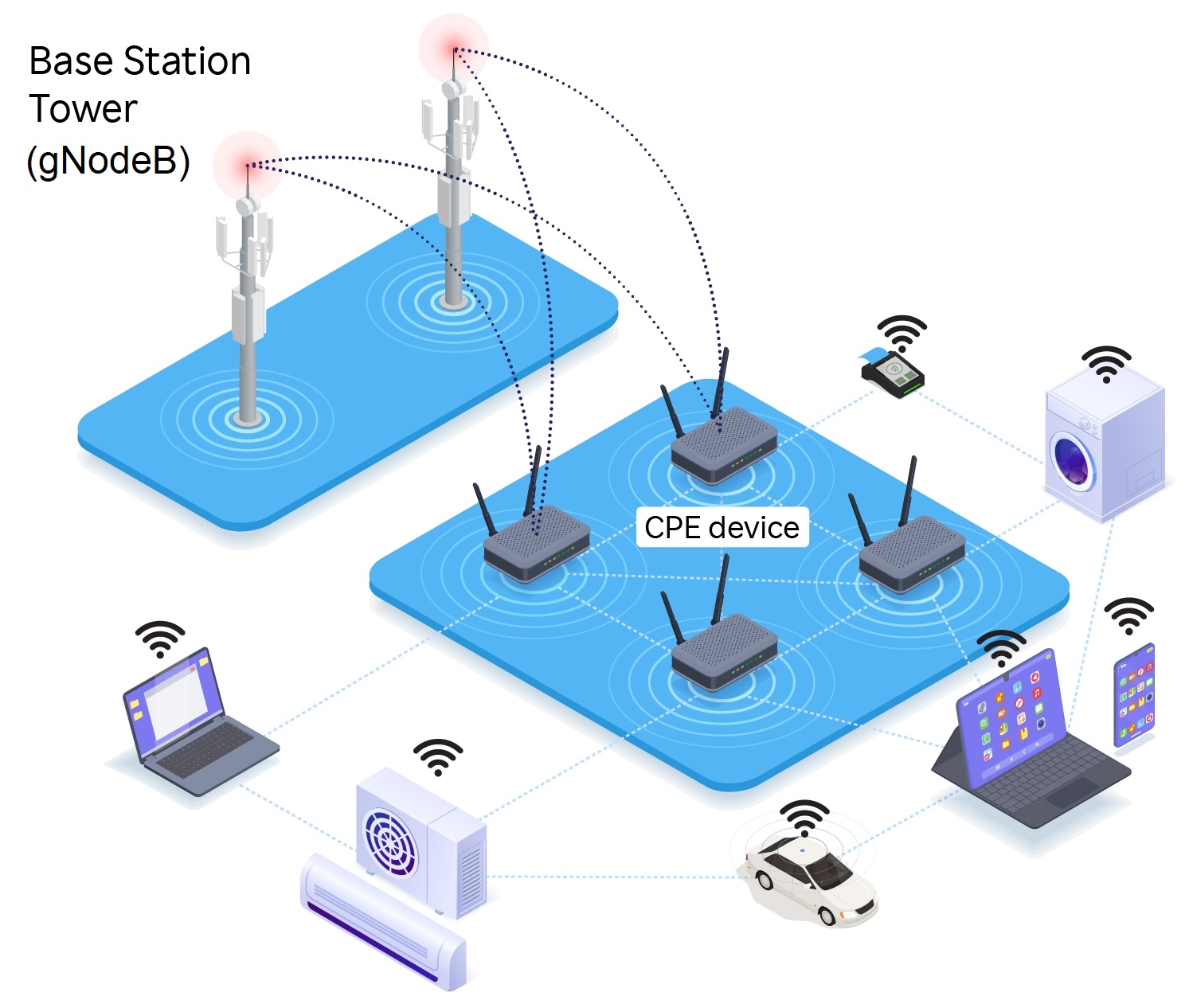
Figure 2. In the FWA use case, CPE devices connect through routers to gNodeB base stations for internet access.
5G FWA (Figure 2) is based on the eMBB use case without handovers or secondary node changes (for non-standalone mode), significantly reducing the complexities involved with mobility. In addition to the disabling of mobility features, FWA also requires a long-lasting radio context that will not go idle or disconnect when data is not detected on the network after a few seconds or minutes. This long-lasting radio layer context enables the streaming of movies or TV shows without concern that the radio contexts won’t be released or made idle in the middle of a program or game. To achieve this, the activity timer is set to 0. Given the number of smart appliances always pinging the network, FWA could never timeout delivering 24-hour live connections. Also, the CPE devices used for FWA are line-powered, not battery-operated. Hence, they don’t need features that optimize battery life.
FWA can be deployed in both FR1 and FR2 frequencies but can achieve higher throughput at FR2 frequencies. The limits of FR2 transmission distance discussed earlier require an outdoor line-of-sight receiver placed on a balcony or rooftop. Signals can get distorted just by passing through a glass window. The receiver also provides better results when it’s as close to the transmitter as possible, as the FR2 coverage radius is around 100 m to 200 m.
An FWA service can be deployed on the same antenna as eMBB, but more likely, the antenna and radio access network (RAN) will be deployed closer to the customer to make up for the relatively short transmission range (especially for FR2). The CPE for an FWA customer includes an RF transceiver for processing and receiving signals from the cellular base station, while towards the on-premises devices, it acts as a Wi-Fi access point, allowing the customer to use the Wi-Fi built for network access and 5G for backhaul to the Internet.
FWA and eMBB from a common base station
The same gNodeB can support FWA CPE devices and mobile UEs simultaneously. The identification of whether the connecting device requires FWA service or mobility is based on Radio Resource Management (RRM) policy index identifiers shared by the core network to the base station when the device attaches. The gNodeB will have different RRM policies for FWA devices and eMBB devices. For example, the RRM policy for an FWA device need not have any measurement configuration to be aimed toward the CPE device because the CPE is stationary.
Conclusion
eMBB and FWA represent significant steps forward in mobile communication services. By understanding their definition, key features, and deployment challenges, MNOs can understand the impact these services have on their own 5G standalone services.
It’s more important than ever for MNOs to deploy 5G services to build their customer base in an emerging market. eMBB is the service that most subscribers will want, replacing 4G connections with a significant improvement in data rate and latency. FWA also offers significant bandwidth for internet-access applications, which lets the MNO tap into a ready market with a much more easily deployed service.