Today’s data rates are already too slow, and so are tomorrow’s. Expect more complaints about slow networks in 2025.
On March 21, 2024, nVIDIA CEO Jensen Huang gave a speech on how AI is changing the world. It has surely changed the attitudes of everyone in the data-communications industry.
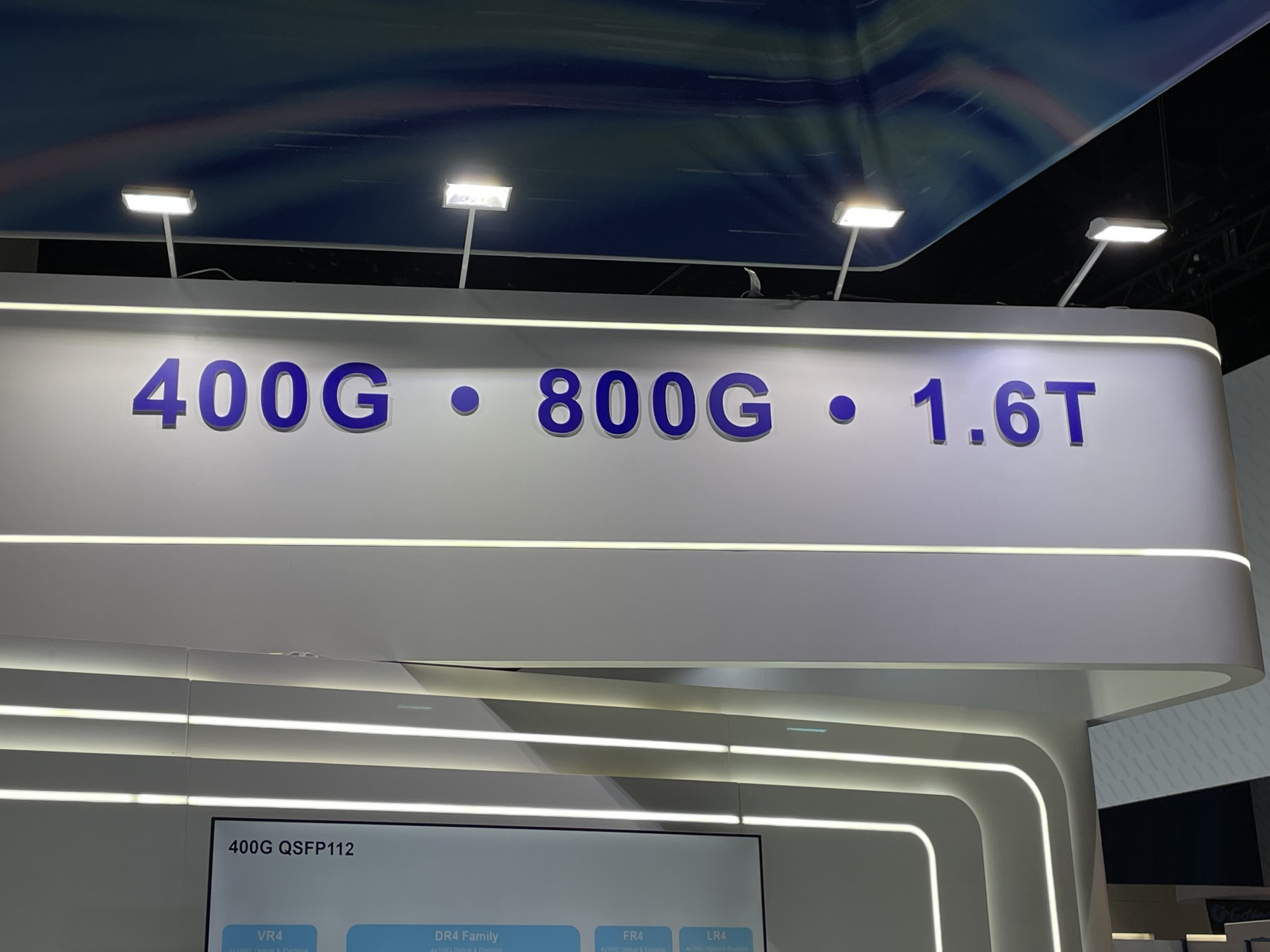
At OFC 2024, many companies were exhibiting components and equipment for 400G and 800G, with demonstration leading to 1.6T.
At OFC 2024, one thing became clear: if you’re in the data communications business, you’d better claim that your company helps move AI-related data or risk being left behind. You see, all the data that those GPUs and CPUs need for AI/ML must move in quantities we never dreamed of before ChatGPT was released. Yes, AI was in use before that day, but now everyone claims to support it.
Having not attended OFC for several years, I expected to hear the usual claims about the need for faster data rates. Numerous people told me that there was a marked change from 2023, and it was because of AI.
In the recent past, we mostly heard that networks needed more speed for transporting video. We also heard about how 5G, with its mmWave capabilities, would enable those faster mobile downloads. Well, mmWave has seen limited deployments. Many people I spoke to at OFC claim that data demands from AI will soon greatly exceed data needs from video and datacenters will be overwhelmed with data. Everywhere I turned at OFC, there was a booth touting AI and how that company’s product — be that network switches, optical network components, semiconductors, and test equipment — would enable AI.
People at OFC 2024 seemed on edge with the jitters. They were wondering if optical data rates could keep up with the coming demand for moving data. They were not concerned about AI taking away their jobs but with how the industry could keep up. Moreover, they were feeling the need to beat their competitors to the next speed.
Optical link rates of 400 Gb/sec (4 × 100 Gb/sec) and 800 Gb/sec (8 × 100 Gb/sec) are in use today, and they were everywhere at OFC. Some companies claimed they are already moving toward 1.6 Tb/sec, known as 1.6T. A few mentioned 3.2T and one presentation included a timeline to 6.4T. What happens if the predictions come true and networks can’t keep up with the expected datacom demands from AI?
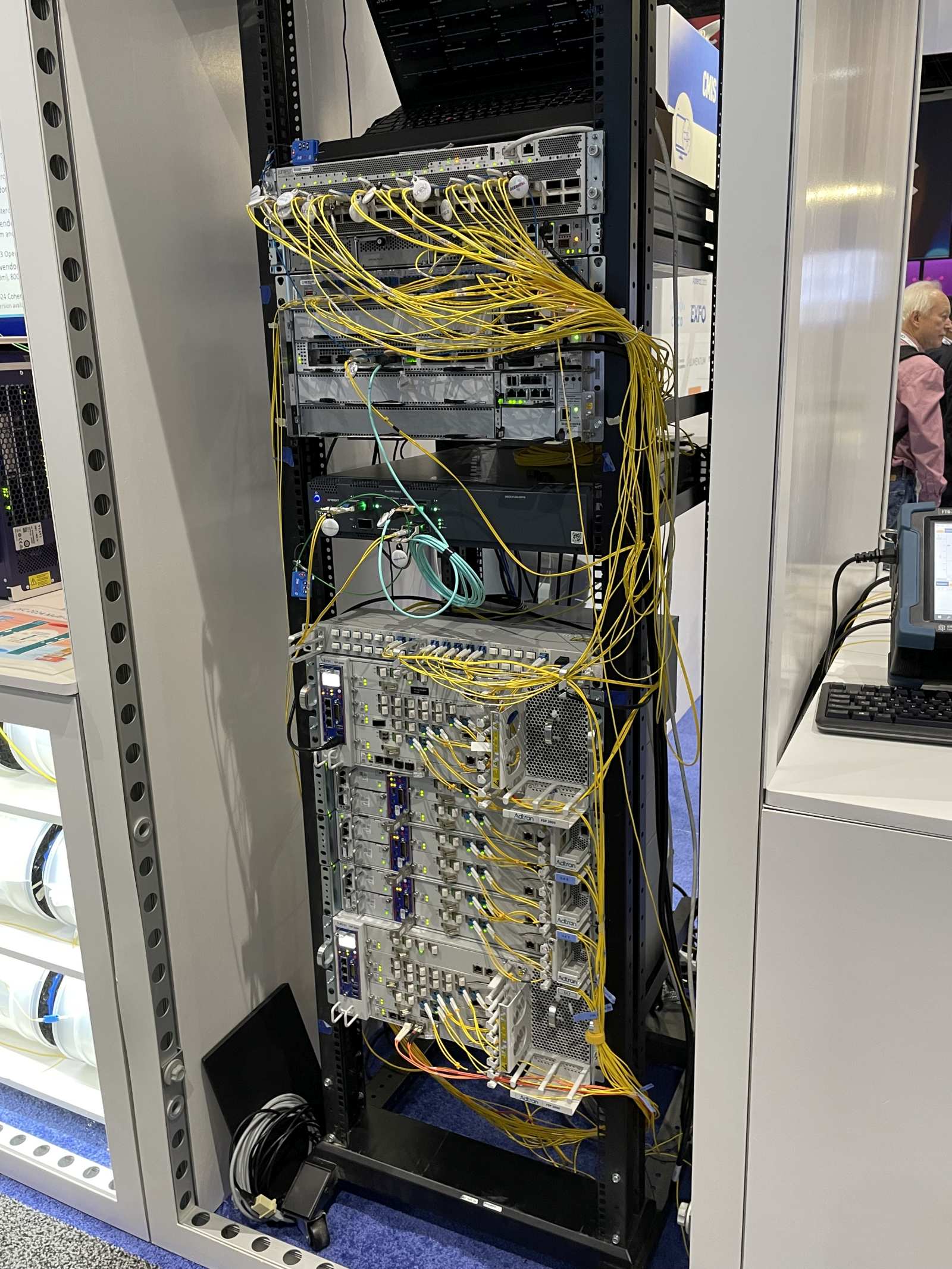
This rack of equipment in the Ethernet Alliance booth demonstrated interoperability among network equipment and components.
Network equipment must interoperate regardless of data rate. To accomplish interoperability, the datacom industry needs standards that make interoperability possible. Some people can’t wait for IEEE to develop and ratify a new speed standard. As a result, companies have joined alliances to develop standards with the hope that they will become the next IEEE standard. One thing everyone agrees on: the connections are all based on Ethernet.
The demand for faster data transport may finally result in the deployment of technologies that have been on the table for some time. Silicon photonics is one such technology. We’ve been hearing about it for years, but now, moving data electrically on boards and in semiconductors may no longer meet demand.
Coherent optics is another technology that has gained importance, both in OFC exhibit-hall products and technical sessions. It uses I/Q modulation, which is common in wireless communications. Coherent optics modulates amplitude, frequency, and polarization, which increases data rates on a fiber.
Today, DSP chips let optical modules convert signals from electrical to optical and back. The DSP takes electrical digital signals, retimes them, and converts them into analog to drive the optical engine.
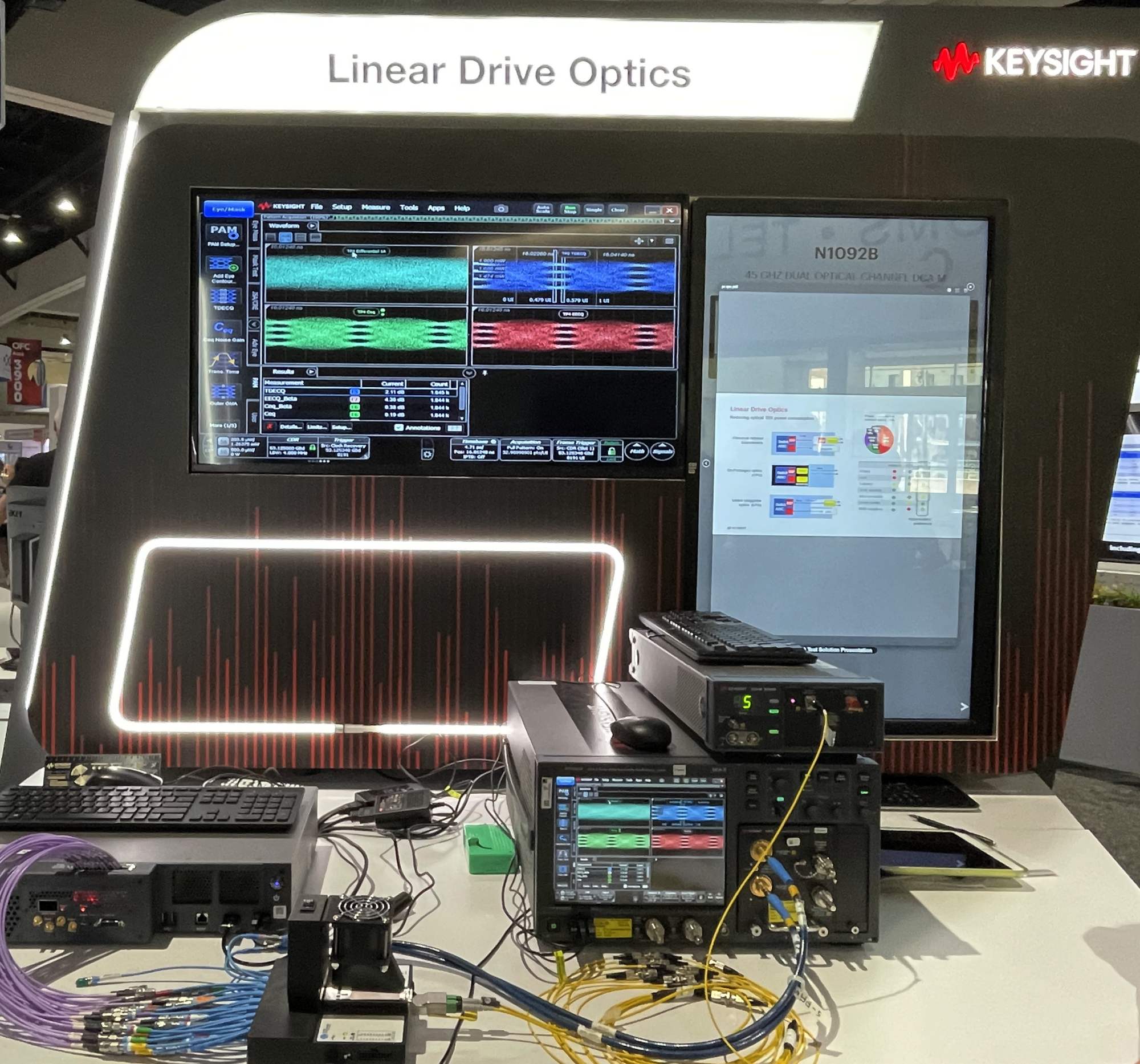
Linear-drive optics moves DSP from the optical module to the datacenter
Linear-drive optics (LDO), also called linear-drive pluggable optics (LPO), moves the DSP out of the pluggable optical module and into the network switch. With LDO, the electrical signal arrives to the module in analog form ready to drive the laser. Shifting to LDO can reduce energy consumption, size, and cost of optical modules because AI is expected to result in many more optical cables in data centers and as computing moves from the cloud to the network edge. Moving DSP chips to the switch makes them easier to cool, and there’s no need to replace the DSP just because the module needs replacement.
The need for speed is already pushing engineers on the electrical side data equation to develop 224 Gb/sec links. Once those links are ready for prime time, we’ll see 800G optical links running on 4 x 200 Gb/sec lanes. The moment that happens, the race for 1.6T (8 x 200 Gb/sec lanes) will be in full swing. In my experience, what we hear at OFC regarding data rates translates into talk at the following year’s DesignCon. Stay tuned; the real race has just begun.